
Contiguous Piling & Secant Piled Walls

Trust • Integrity • Expertise • Your Foundation Partner – Trust • Integrity • Expertise • Your Foundation Partner – Trust • Integrity • Expertise • Your Foundation PartnerTrust • Integrity • Expertise • Your Foundation Partner – Trust • Integrity • Expertise • Your Foundation Partner – Trust • Integrity • Expertise • Your Foundation Partner
Contiguous Piling & Secant Piled Walls2026-01-14T18:37:29+00:00
Cooling Towers at Power Plant Facility

Advanced Retaining Wall Systems

Ancora Foundations

Contiguous & Secant Piling

Contiguous Piling & Secant Piled Walls

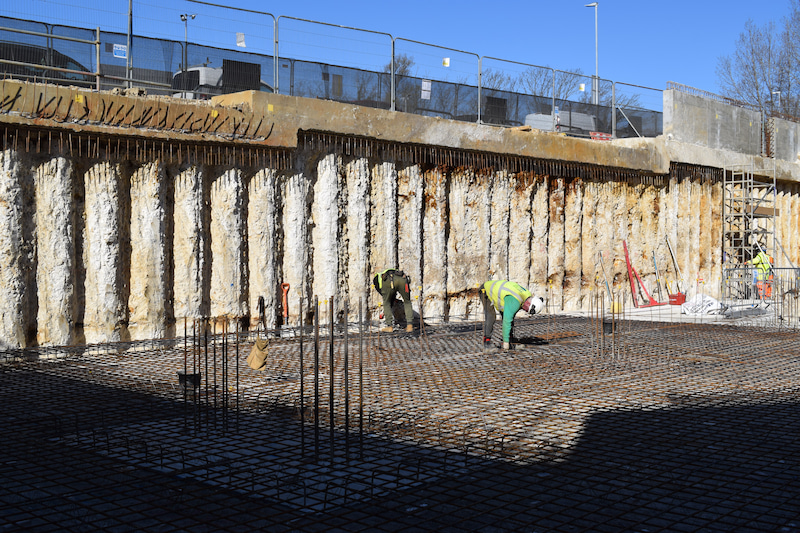
Contiguous and Secant Piled Walls are structural retaining systems formed using bored cast-in-place piles, designed to retain earth, support excavations, and form permanent or temporary basement walls. At Ancora Foundations, we design and construct both Contiguous Pile Walls and Secant Piled Walls, tailored to the site’s geotechnical conditions and engineering requirements. These systems are widely used where space is restricted, where temporary excavation support is required, or where groundwater control is essential.

1. Contiguous Piled Walls

A Contiguous Piled Wall is formed by drilling a series of bored piles at close centres, typically leaving a small gap between each pile (usually 50–150 mm). This type of wall is suitable for cohesive and stable soils where groundwater ingress is minimal. The open gaps between the piles allow for efficient drainage while providing strong lateral earth retention.

Key Advantages:

  • Economical retaining solution for dry or partially cohesive ground
  • Faster installation compared to diaphragm or secant walls
  • Excellent option for temporary works, basements, and slope stabilisation
  • Allows for drainage through gaps reducing hydrostatic pressure buildup
  • Integrates easily with capping beams and reinforced slabs
Specification Typical Range / Capability

2. Secant Piled Walls

A Secant Piled Wall is formed by overlapping interlocking bored piles — alternating between soft primary piles and reinforced hard secondary piles. This method creates a continuous barrier that can be watertight, structurally robust, and capable of resisting significant lateral and hydrostatic pressures.

Key Advantages:

  • Provides a continuous structural wall with excellent water retention
  • Suitable for deep excavations, basements, shafts, and retaining structures
  • High bending resistance and lateral capacity
  • Customisable for both temporary and permanent works
  • Can be incorporated into the final structure as a permanent basement wall
Design Parameter Typical Range / Capability

Typical Applications

  • Basement excavations for commercial and residential developments
  • Retaining walls adjacent to roads, railways, and boundary structures
  • Underpinning and deep foundation systems
  • Infrastructure and civil engineering works requiring temporary or permanent support
  • Stabilisation of slopes, cuttings, and embankments
Engineering Design

In-house geotechnical and structural design capability, including finite element design.

Versatile Solutions

Customisable solutions for both temporary and permanent works, including watertight basements.

Why Clients Choose Ancora: Quality-focused, fast turnaround, fully compliant, and commercially efficient.

Services FAQ

For sites with limited access or low headroom (like basements or rear gardens), we use SFA (Segmental Flight Auger), Grundomat, or Helical piling. These methods utilise compact, handheld, or modular equipment that avoids the need for large rigs.
We use ODEX piling for challenging strata. This method cases the hole simultaneously while drilling, preventing bore collapse in loose soil and allowing us to penetrate through boulders, fill, or rock obstructions securely.
Yes. Beyond piling, our Reinforced Concrete (RC) teams construct piled rafts, ground beams, and retaining walls. This ‘one-stop’ approach ensures seamless integration, faster delivery, and clearer accountability for your project.
Absolutely. We specialise in vibration-free and low-noise techniques (such as CFA, SFA, and Helical piling) that protect adjacent structures and minimise disruption to neighbours, fully compliant with environmental standards.
Yes. We design and install Contiguous and Secant piled walls to retain earth and exclude water for basement excavations. These are engineered to withstand high lateral loads and integrate with the final structure.
We operate with strict adherence to Eurocode 7, BS EN standards, and NHBC requirements. We provide full design warranties, collateral warranties, and comprehensive Quality Assurance (QA) logs for every pile installed.
How can factories improve product quality?2024-05-07T20:40:27+00:00

Factories can improve product quality by implementing quality control measures, using advanced technology, providing training to employees, and listening to customer feedback.

How does robotics benefit manufacturing?2024-05-07T19:48:05+00:00

Robotics improves manufacturing by increasing efficiency, precision, and safety, while also reducing labor costs and repetitive tasks.

How can factories reduce energy consumption?2024-05-07T19:53:40+00:00

Factories can reduce energy consumption through measures such as upgrading equipment, optimizing processes, implementing energy-efficient technologies, and using renewable energy sources.

What is Lean Manufacturing?2024-05-07T19:41:30+00:00

Lean manufacturing is a systematic approach aimed at minimizing waste while maximizing productivity and efficiency.

How can Industry 4.0 improve factory operations?2024-05-07T19:47:03+00:00

Industry 4.0 can improve operations by enabling real-time monitoring, predictive maintenance, process optimization, and enhanced decision-making.

get a free quote
Go to Top